
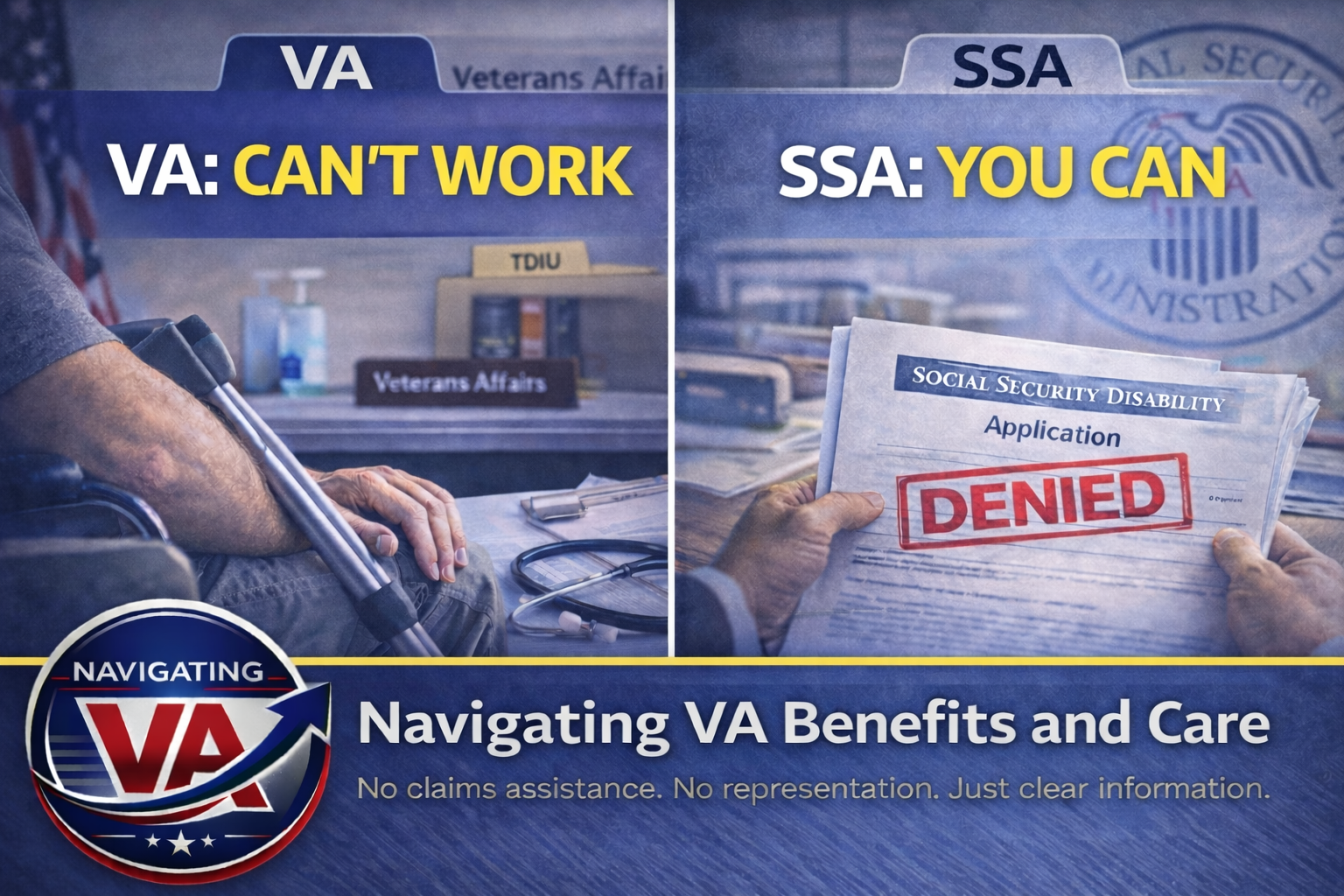
VA says a veteran cannot work. Social Security may still deny the claim.
This article examines how VA disability findings are evaluated in Social Security disability decisions, and what the data shows when those conclusions do not align.
A veteran can be found unable to work, or individually unemployable, by the Department of Veterans Affairs and still be denied disability benefits by Social Security. The same person, the same conditions, and the same debilitating limitations, but two different conclusions. This is not unusual, and it is not treated as a problem.

Two Agencies, Two Questions
Both agencies evaluate disability. Both rely on medical evidence. Both are reviewing the same conditions, with Social Security often evaluating additional conditions or limitations. But they do not frame the question the same way.
The VA asks whether the veteran can work. Social Security describes its role differently, focusing on what the person can still do, what jobs match those abilities, and whether those jobs exist. From their perspective, this is treated as a different inquiry, even though it relies on the same underlying limitations.

How Prior Findings Are Treated
When the VA finds a veteran unable to maintain substantially gainful employment, that is a direct conclusion about work capacity. But Social Security is not required to follow that conclusion. Federal courts have addressed how VA findings are evaluated. In McCartey v. Massanari, the court held that VA disability rating determinations must be given significant weight [1]. If Social Security reaches a different conclusion, it must provide specific and persuasive reasons supported by the record.
Social Security policy adds an important distinction. Determinations made by other agencies are not given specific evidentiary weight. Instead, the evaluation focuses on the underlying medical evidence used to support those findings. That distinction matters. A one hundred percent rating reflects total occupational impairment within the VA rating schedule. Ratings below one hundred percent do not.
A finding of unemployability reaches a similar conclusion through a different path. It determines that the veteran cannot maintain substantially gainful employment, even though the underlying schedular rating is less than one hundred percent. Both appear in the same record, but they are different types of findings and are not treated the same way. The process recognizes prior findings, but it does not require the same outcome.
The Unanswered Question
When two agencies review the same person using overlapping evidence and reach different conclusions, one question should follow: Why are these findings different?
The process does require an answer to that question. When Social Security reaches a different conclusion, it must explain why and support that explanation with the record. But that requirement has limits. The explanation does not have to lead to a consistent result. The process does not require the two conclusions to be reconciled. A different decision can still be reached on the same record, even when both agencies are evaluating the same underlying limitations.
The question becomes more focused. Veterans rated one hundred percent show higher approval rates. Veterans found unemployable do not. Both findings come from the same agency. Both appear in the same record. But they do not carry the same result.
That leads to a practical question. Would the outcome be different if the same veteran, found unemployable, instead held a one hundred percent schedular rating at the time of the Social Security decision? The data does not answer that question directly. But it does suggest that the type of VA finding may influence how the claim is evaluated.
What is happening with a one hundred percent rating that is not happening with a finding of unemployability? The process does not provide an answer. Two different conclusions about the same injury can be explained, but not resolved.
One point stands out. A one hundred percent rating reflects total occupational impairment under the VA rating schedule. Ratings below one hundred percent do not. When a claim involving a one hundred percent rating is denied, that difference stands out and requires explanation. When the underlying rating is less than one hundred percent, even if the veteran has been found unemployable, that same contrast is not as clear within the rating itself.
This does not appear to be a problem with the evidence. It reflects how the process is built. Social Security is required to give significant weight to VA disability rating determinations and to explain when it reaches a different conclusion [1]. But that requirement is tied to the rating. A finding of unemployability reaches a direct conclusion about the ability to work, but it is not expressed as a rating percentage.
What the Data Reveals
Veterans rated one hundred percent show higher approval rates for Social Security disability than the general applicant. Veterans found unemployable do not [2].
That result is unexpected.
A finding of unemployability is a direct determination that a veteran cannot maintain substantially gainful employment. A schedular rating, even at one hundred percent, does not necessarily carry that same conclusion. If both findings are being considered, the results should reflect that distinction. It would be reasonable to expect approval rates for veterans found unemployable to be equal to or greater than those rated one hundred percent. But the data does not reflect that distinction.
There are also indications within the process itself that certain VA findings receive additional attention. Social Security procedures identify and expedite claims involving veterans with a one hundred percent Permanent and Total rating, treating those cases as priority workload [3]. That designation is tied to total disability status and is applied based on how that status is identified within the VA system.
The data provides a clear answer.

Veterans rated one hundred percent are approved at higher rates than the general applicant population at the initial stage. Veterans found unemployable are not. Their approval rates are nearly identical to all applicants [2].
That difference is consistent across the data.


As cases move through the process, that gap narrows. At the hearing level, approval rates become more aligned. But the initial stage is where most claims are decided, and it is where the difference is most pronounced.
This raises a more focused question.
If both findings reflect total disability within the VA system, why does one show a measurable advantage while the other does not?
The data does not answer that question directly. But it does show that the type of VA finding is associated with different outcomes.
What This Means
The law requires that differences be explained. The data shows that outcomes still diverge.
A one hundred percent rating reflects total occupational impairment under the VA rating schedule. A finding of unemployability directly addresses the ability to work. Both are based on the same conditions. Both appear in the same record. But they do not carry the same result.
The process explains how a different conclusion can be reached. It does not answer why similar findings lead to different outcomes.
The data does not resolve that question. It makes it visible.
One possible explanation is reflected in how these findings appear in the data. A one hundred percent rating clearly reflects total occupational impairment. When that finding is not followed, the difference is clear and must be addressed by law. When the underlying VA rating is less than one hundred percent, even with a finding of unemployability, that same contrast is not as clear when viewed through the rating percentage itself. That difference may result in a lower threshold for explaining a denial, since the underlying rating percentage does not reflect total occupational impairment.
A veteran found unemployable should be assured that this finding is being evaluated on, at minimum, the same basis as a one hundred percent rating. That is the standard the process should meet. Veterans are not looking for more than they are entitled to. They are looking for a fair determination of their eligibility for benefits. Social Security disability decisions should reflect that.
References
[1] McCartey v. Massanari, 298 F.3d 1072 (9th Cir. 2002)
https://law.justia.com/cases/federal/appellate-courts/F3/298/1072/643062
[2] Social Security Administration. Social Security Bulletin, Vol. 74, No. 3.
https://www.ssa.gov/policy/docs/ssb/v74n3/v74n3p1.html
[3] SSA. HALLEX I-2-1-40 — Critical Cases Procedures
© 2026 Navigating VA Health Care and Benefits. All rights reserved.
This article may not be reproduced without permission. Excerpts may be used with attribution and a link to the original source.
Next Steps
Real Examples
Full Walkthrough
See how VA rules and evidence shape real cases.
Step-by-step breakdowns of how the system works.