
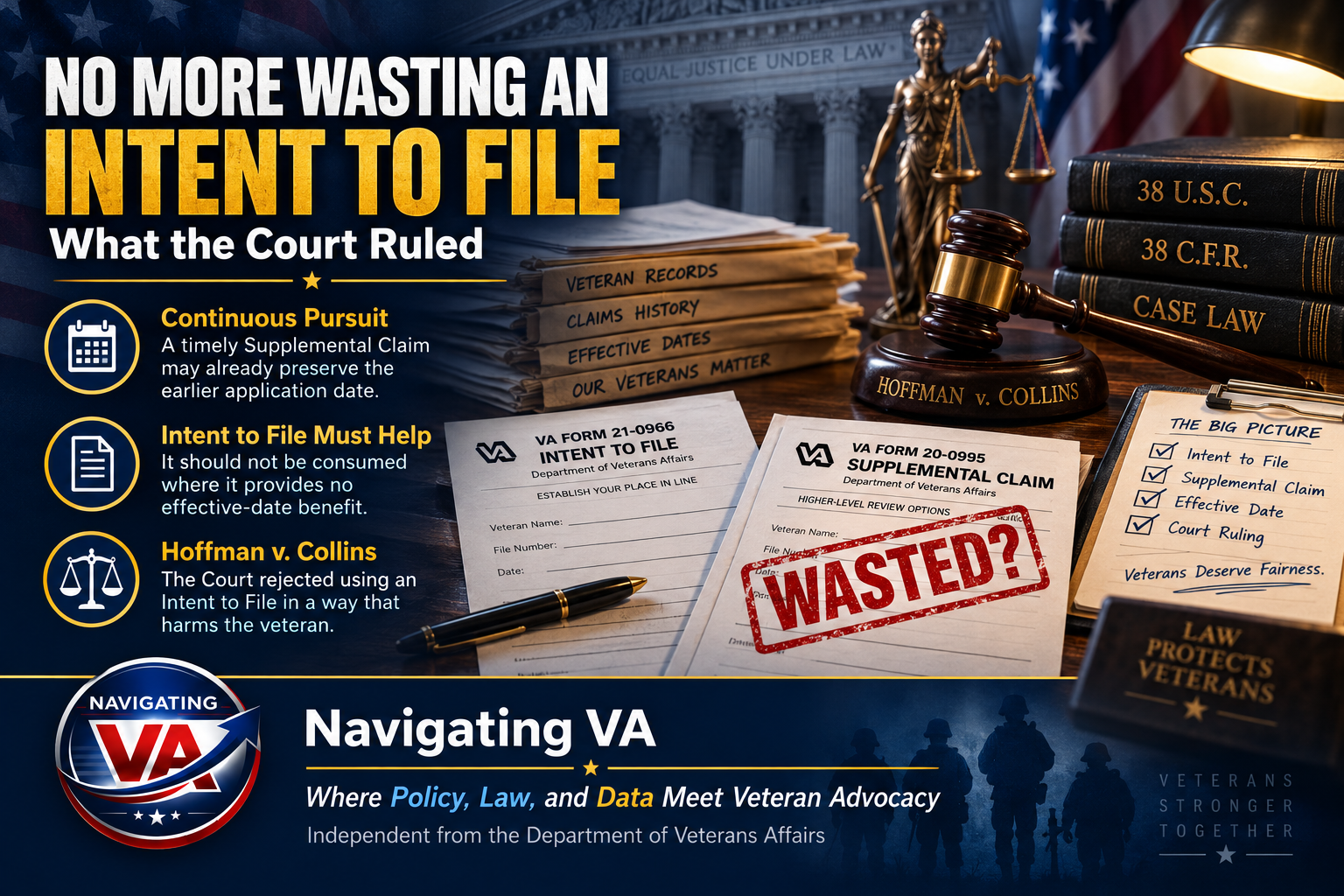
An Intent to File can protect months of potential VA disability compensation while a veteran gathers the evidence needed to complete a claim.
But what happens when a veteran already has another claim in progress and files a Supplemental Claim before completing the new claim?
Can the VA attach the Intent to File to the Supplemental Claim, even when doing so provides the veteran no benefit, and then refuse to apply it to the new claim where it actually matters?
In Hoffman v. Collins, No. 24-7834, the U.S. Court of Appeals for Veterans Claims said no.

This Article Explains:
- How the Intent to File Was Lost
- The Supplemental Claim Already Had Better Protection
- An Intent to File Cannot Be Wasted This Way
- This Does Not Apply to Every Supplemental Claim
- What This Means for You
How the Intent to File Was Lost
Robert Hoffman filed an Intent to File on February 28, 2023. A few months later, he filed a Supplemental Claim involving disabilities that had been previously denied and that he was continuously pursuing.
Then, on July 21, 2023, still within one year of his Intent to File, Hoffman submitted new claims and specifically asked the VA to associate them with his February Intent to File. The VA eventually granted service connection for those new claims, but it did not use the February date. Instead, the VA assigned July 21, 2023, the date it received the new claims, as the effective date.
Why?
The VA determined that Hoffman’s May Supplemental Claim had already used his February Intent to File. Under the VA’s interpretation of 38 C.F.R. § 3.155(d)(1)(ii), only one complete claim for a particular benefit can be associated with an Intent to File. Because the Supplemental Claim came first, the VA treated the Intent to File as already used. The problem was that the Intent to File did absolutely nothing for that Supplemental Claim.
The Supplemental Claim Already Had Better Protection
This is where the case becomes important. Under 38 U.S.C. § 5110(a)(2), a veteran who continuously pursues a claim by filing a qualifying Supplemental Claim within one year can preserve the date associated with the original application.
Hoffman’s Supplemental Claim was already protected by that rule. His original claims had been filed before the February 2023 Intent to File. Attaching the later Intent to File to those continuously pursued claims could not give him an earlier effective date. It provided him nothing. But using the Intent to File on the Supplemental Claim prevented it from being used for his new claims, where it could have protected several additional months of benefits.
The Court rejected that result.
An Intent to File Cannot Be Wasted This Way
The Court concluded that Congress had already established how the date of application works for a continuously pursued Supplemental Claim. When continuous pursuit applies, the claim is tied back to the initial application. There is no effective-date work left for the later Intent to File to perform. The Court explained that applying the Intent to File to such a Supplemental Claim would either conflict with the effective-date rule Congress created or simply harm the veteran by preventing the Intent to File from being used for a new claim.
That was the problem in Hoffman’s case.
The VA took an Intent to File that provided no benefit to his Supplemental Claim and effectively made it unavailable for the claims that could actually benefit from it. The Court held that the VA exceeded its legal authority by applying the Intent to File framework that way.
This Does Not Apply to Every Supplemental Claim
There is an important limitation in Hoffman. The Court did not hold that an Intent to File can never apply to a Supplemental Claim. The problem involved a continuously pursued Supplemental Claim, meaning a Supplemental Claim filed within the period that preserves the earlier claim date under 38 U.S.C. § 5110(a)(2).
A Supplemental Claim filed outside continuous pursuit presents a different effective-date situation, and an Intent to File may provide an actual benefit. The important question is not simply whether a Supplemental Claim was filed. The question is whether attaching the Intent to File to that Supplemental Claim actually provides an effective-date benefit or merely wastes the Intent to File.
What This Means for You
Veterans often have more than one claim moving through the VA system at the same time. You may be preparing a new disability claim while also filing a Supplemental Claim on something the VA recently denied. Until Hoffman, those two actions could collide in a way that cost a veteran months of benefits.
If you filed an Intent to File, later filed a continuously pursued Supplemental Claim, and then filed another compensation claim within one year of the Intent to File, look carefully at the effective date assigned to the later claim. If the VA says the Intent to File was already used by the Supplemental Claim, Hoffman v. Collins may matter.
The lesson is simple:
An Intent to File exists to protect an effective date. It should not be consumed by a continuously pursued Supplemental Claim when it provides that claim no effective-date benefit at all.
Effective dates can involve some of the most technical rules in the VA claims system, but they directly determine how much compensation a veteran receives. A mistake involving only a few months can mean the loss of hundreds or thousands of dollars in benefits.
This is also where experienced representation matters. Accredited representatives, such as Veteran Service Officers that are available at no cost, can review the history of a claim, identify whether continuous pursuit applies, and determine whether the VA correctly applied an Intent to File when assigning an effective date.