
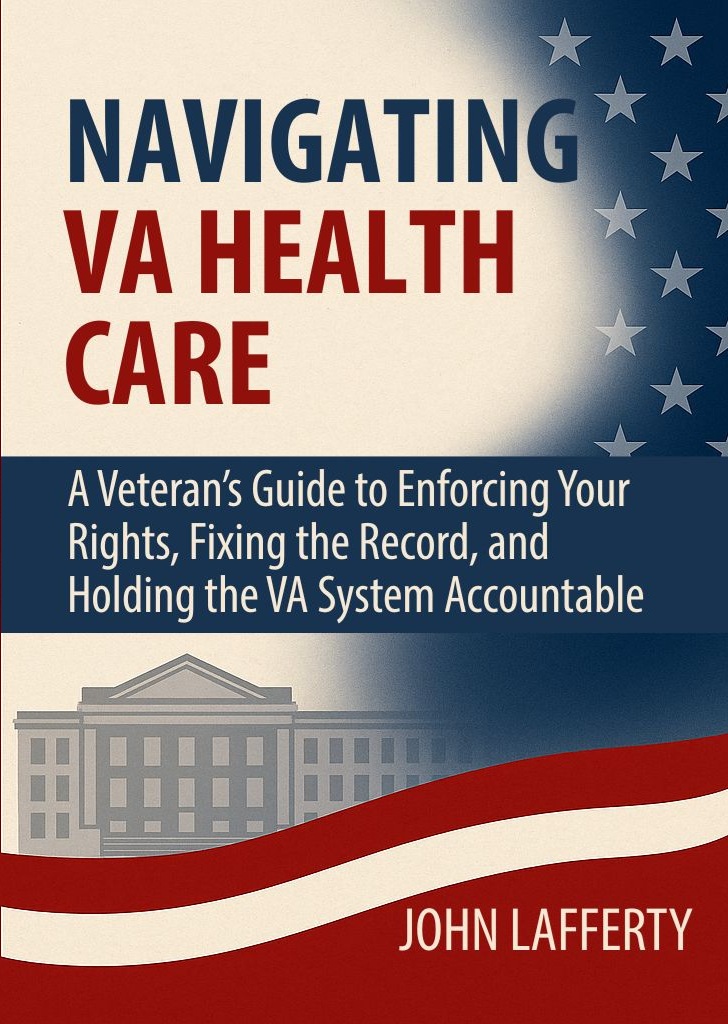

Navigating VA Health Care
A practical, policy-grounded guide for Veterans, caregivers, advocates, and professionals who need to understand how the VA health care system is structured, what standards govern it, and how to respond effectively when communication, coordination, documentation, or accountability breaks down.
Purchases, secure checkout, and shipping are handled through Amazon.
Understand the System Before You Challenge It
The Veterans Health Administration is governed by federal law, regulations, directives, handbooks, clinical structures, and administrative processes. Yet Veterans are often expected to navigate that system without being shown how those pieces fit together.
This book translates that structure into practical action. It explains who is responsible, what standards apply, how to document failures, how to correct the record, and how to escalate unresolved concerns through the appropriate accountability channels.
Understand the Structure
Learn how VA health care is organized, how VAMCs, CBOCs, PACT teams, social work, specialty care, and Patient Advocacy fit into the larger system.
Use Policy as a Tool
Understand how federal law, VA regulations, and VHA directives establish standards for care, communication, advocacy, service recovery, and accountability.
Build a Record That Matters
Learn how to document delays, request written explanations, correct inaccurate medical records, organize evidence, and create a paper trail that supports meaningful review.
Inside the Book
The book moves from understanding the VA health care system to using its own policies, complaint structures, documentation requirements, and oversight channels effectively.
- Understand how VA health care is organized and where responsibility sits.
- Understand Veteran Patient Experience standards and service recovery.
- Use Patient Advocates more strategically when care breaks down.
- Identify the laws and policies governing the Patient Advocacy Program.
- Use VA directives and regulations to support written requests.
- Recognize when local practices conflict with formal VA policy.
- Write complaints that are factual, organized, and difficult to dismiss.
- Escalate unresolved concerns through facility, VISN, and national leadership.
- Understand when congressional or OIG involvement may be appropriate.
- Request medical statements and completion of disability-related forms.
- Amend inaccurate, incomplete, or misleading VA medical records.
- Recognize hidden statements in the record that may affect future decisions.
- Use social work, Whole Health, and the PACT structure more effectively.
- Maintain a complaint log and structured paper trail.
The Central Principle
VA health care does not operate only through medical judgment. It operates through policy, documentation, defined responsibility, and administrative process.
When something goes wrong, the strongest response is not simply to repeat the complaint. It is to identify the governing standard, document the breakdown, make a specific request, and move through the accountability structure deliberately.
You do not need permission to create a record, ask for the controlling policy, request a written explanation, or escalate an unresolved breakdown through the system’s own chain of accountability.
Who Should Read This Book?
This book is designed for Veterans navigating VA health care and the people helping them understand, document, and address system failures.
Veterans Using VA Health Care
- Experiencing delayed referrals, unanswered messages, or fragmented care
- Trying to understand who is responsible for resolving a problem
- Preparing a formal complaint or escalation
- Seeking correction of inaccurate medical records
- Trying to obtain completed forms or medical statements
Caregivers and Family Members
- Helping a Veteran communicate with the health care system
- Tracking appointments, referrals, messages, and unresolved issues
- Supporting a Veteran during complaints or escalation
- Reviewing records for inaccuracies or missing information
- Building a reliable paper trail when the Veteran cannot do so alone
VSOs and Veteran Advocates
- Understanding the distinction between VBA claims and VHA care
- Helping Veterans identify the correct health care escalation path
- Recognizing relevant directives, statutes, and complaint mechanisms
- Helping organize timelines, records, and supporting documentation
- Using the book as a recurring health care advocacy reference
Healthcare, Policy, and Casework Professionals
- Understanding how Veterans experience fragmented VA systems
- Recognizing where communication and coordination frequently fail
- Understanding Patient Advocacy and leadership accountability
- Reviewing constituent concerns within the correct VA structure
- Connecting policy requirements to real-world implementation
Book Structure
The book is organized to move from understanding the VA health care system to policy-based advocacy, escalation, record correction, and coordinated care.
Practical Appendices
Legal and Policy Authorities
Key VA directives, federal statutes, regulations, handbooks, and policy references used throughout the book.
VA Terms and Structure
Definitions of common VA terms, offices, roles, acronyms, and entities Veterans encounter while navigating care.
Complaint Templates
Working complaint examples and structures that can be adapted for Patient Advocacy, leadership, VISN, congressional, and oversight communications.
Complaint Strategy Table
A quick-reference framework for selecting the correct audience, tone, evidence, authority, and requested resolution.
Contact and Paper-Trail Log
A framework for recording dates, communications, VA responses, governing policies, unresolved actions, and next steps.
Record Amendment Guide
A practical process for requesting correction of inaccurate, incomplete, untimely, or misleading VA medical records.
A Working Reference for Navigating VA Health Care
This book is designed to be used when a Veteran needs more than a general explanation. Its chapters, templates, appendices, authorities, and documentation tools are organized for repeated reference.
Grounded in Authority
The book connects real-world VA health care problems to federal law, VA regulations, VHA directives, handbooks, and accountability structures.
Built Around Documentation
It explains how timelines, secure messages, medical records, complaint logs, written requests, and supporting exhibits can be organized into a credible paper trail.
Focused on Effective Action
The objective is not conflict. It is to identify the correct standard, communicate precisely, request a defined resolution, and move to the next level when necessary.
Navigating VA Health Care
A practical guide to understanding VA health care structure, enforcing patient rights, using VA policy, working with Patient Advocates, escalating unresolved problems, correcting medical records, and building a documented case for accountability.
You will be taken to Amazon to complete your order. Amazon handles secure checkout, order processing, and shipping.