Integrated Case Management
When several teams are involved in your VA care, find out how to ask for help coordinating referrals, follow-up, and transitions between care settings.
Where are you now?
What a VA case manager can help you do
When you have complex care needs, a VA nurse or social work case manager can help you and your care teams agree on a plan and make sure everyone knows who is handling each step.
- Build a care plan across teams. Work with you, your VA clinicians, and community providers to agree on priorities and next steps.
- Keep referrals and follow-up on track. Help clarify who is handling each step and work with you on barriers to getting care, such as transportation.
- Keep the plan current. Check how things are going and adjust the plan with you as your needs change.
What coordination can look like after a hospital stay
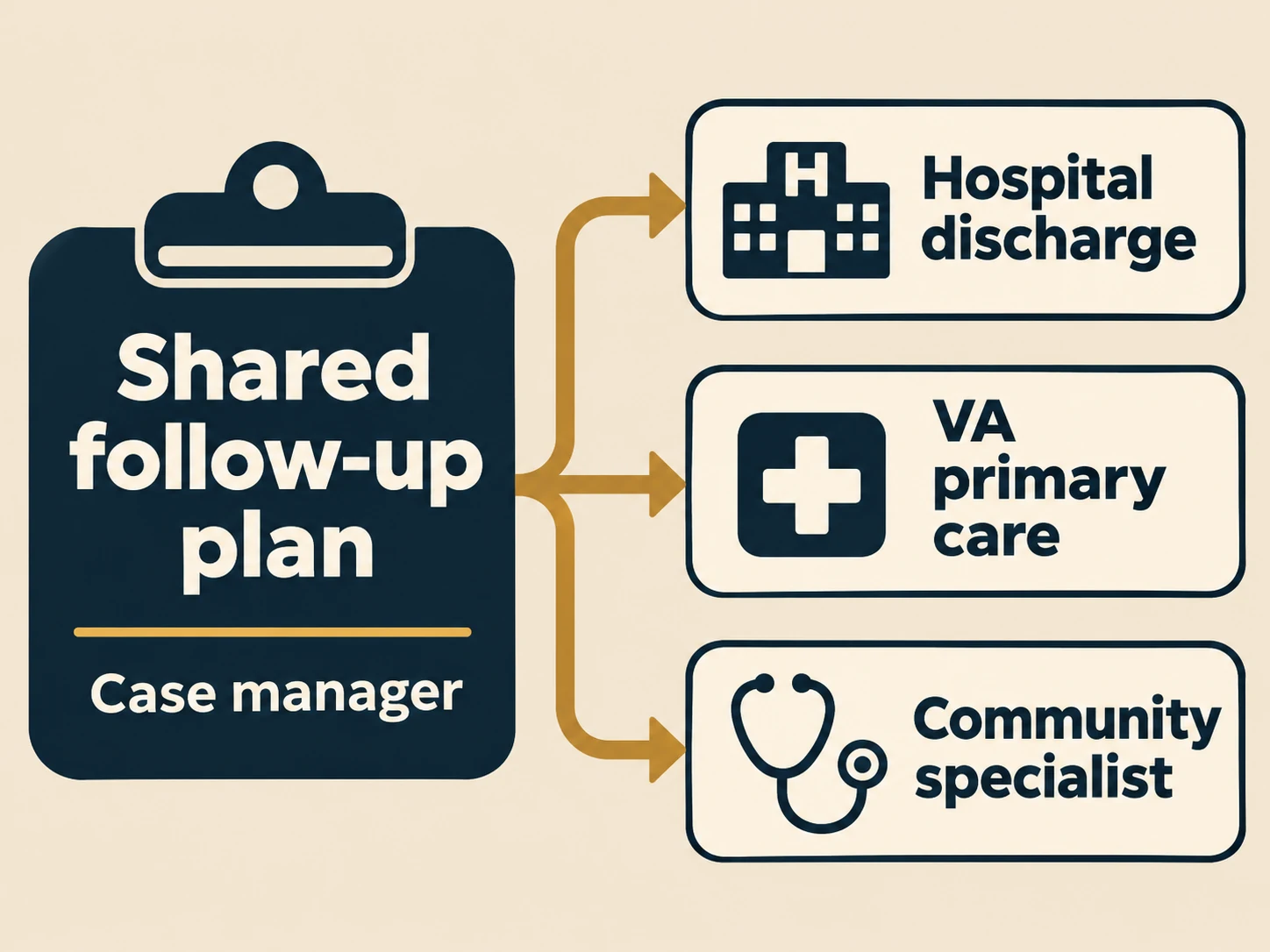
After a hospital stay, a veteran may need follow-up with both their VA primary care team and a community specialist. An assigned case manager can help the teams agree on who will arrange each follow-up, how they will share the discharge instructions, and whom the veteran should call if an appointment falls through. See paragraph 7(c) of the directive.
Who may qualify for a VA case manager?
When case management may help
VA offers a nurse or social work case manager when screening shows you need complex care coordination. That can include a major change in health or daily functioning, a difficult transition home from the hospital, or ongoing help keeping care on track across several teams. Your health can be stable and you can still need ongoing support to get care. Eligibility criteria depend on the clinical program and the conditions it serves.
What VA looks at
VA uses a standard screening tool to review your health needs, risks, and how often you need help managing care. A case manager’s fuller assessment can cover practical barriers such as transportation, housing, finances, and the support you have at home.
How to request screening
You can ask for screening yourself. A family member or caregiver can also make a referral. Tell your VA primary care team or a VA social worker what you’re having trouble managing and ask, “Can you screen me for case management under VHA Directive 1110.04(1)?”
See paragraphs 2, 3, 7(c), and 8 of the Integrated Case Management directive.
Ask your VA team for help
Start with your VA primary care team or a VA social worker. You can raise the need yourself. A family member or caregiver can also make a referral. Explain where coordination is breaking down and what help would make a difference.
What to tell your team
- Who is involved. Name the clinics, specialists, or community providers you’re working with.
- What is pending. Bring referral dates, discharge instructions, or questions about who is following up.
- What is getting in the way. Explain barriers such as transportation, difficulty managing appointments, or changes in the help you have at home.
What to ask for
- An assessment. Ask VA to review what level of care coordination fits your needs.
- A main contact. Ask who is coordinating your care and how you can reach that person.
- A follow-up plan. Ask who will take the next step, when to expect an update, and whom to call if you haven’t heard back.

You can say, “I’d like to be screened for specialty case management under VHA Directive 1110.04(1) on Integrated Case Management. Can you refer me to the specialty case management team that works alongside my PACT nurse?”
If you haven’t heard back
Follow up with the VA team you asked. Confirm whether the screening referral was placed, who is handling it, and when you should expect an update.
If the concern remains unresolved after you’ve followed up with your care team, your VA medical center’s Patient Advocate can help you get it addressed. Find out how to contact a VA Patient Advocate.
How VA matches support to your needs
VHA Directive 1110.04(1) sets standards for integrated case management. VA screens for clinical eligibility and considers your health needs, risks, and ability to manage your care. The directive describes three levels of support.
Basic care coordination
Help finding your way through VA care, getting information, and connecting with referrals.
Moderate care management
Ongoing support with managing a health condition, including education, prevention, and help accessing services.
Complex case management
A trained clinical case manager helps develop and oversee a care plan for more complex needs, including care across teams or settings.
What happens after a referral
- VA screens your needs. Complex situations may go to the facility’s Care Coordination Review Team for a recommendation about the level of support and main contact.
- You help shape the plan. If VA offers you case management and you agree, the case manager assesses your needs and works with you and your care team on goals and next steps. Family or caregivers can be involved as appropriate.
- The team follows up. The case manager documents the assessment and care plan in your VA health record, monitors progress, and adjusts support as your needs change.
If VA recommends different support or case management ends
If VA recommends basic care coordination or moderate care management, ask which team will provide it, what help you can expect, and whom to contact. If specialty case management ends, ask who will take over care coordination and follow up on any open referrals.
If your care becomes more complex or you face new barriers to getting care after case management ends, ask for another screening referral. The directive says VA should refer veterans for screening again in these circumstances. See paragraphs 7(c) and 8(c) of the directive.
Ask for specialty case management. When you ask for a case manager, staff may direct you to your PACT RN care manager. Ask to be screened or referred for specialty case management under VHA Directive 1110.04(1).
Your PACT RN continues to coordinate your primary care. A specialty case manager, when assigned, has a separate role coordinating your complex care across teams. VA can assign a registered nurse or a social worker to that role. See paragraph 7(c)(3) and Appendix A.3 of the directive.
What a Lead Coordinator does
When a Lead Coordinator is assigned, that person is your main contact for coordinating care across teams and settings. The directive recommends this role when more than one case manager is involved in complex care. A care coordinator, care manager, or case manager can fill the role.
- Connects the teams. Helps providers share information, carry out the care plan, and coordinate referrals or a transfer between care settings.
- Keeps you informed. Stays in touch with you and, as appropriate, your family or caregiver. Ask which contact method to use and how often to expect an update.
- Helps with handoffs. If your coordination support changes, ask who will take over open referrals and whom you should contact next.
For complex case management, the directive describes different tiers and contact frequencies. Ask which tier your program uses for your care and when you should hear from your case manager. See paragraphs 5(m), 7, and 8 of the directive.
Read the directive
VHA Directive 1110.04(1), Integrated Case Management Standards of Practice. Issued September 6, 2019 and amended May 18, 2020. VA’s directives catalog continues to list it.
VHA Notice 2026-01, issued May 5, 2026, waives Commission on Accreditation of Rehabilitation Facilities (CARF) accreditation requirements in this directive and other listed policies.
How to work with your VA care team · More VA health care resources