VA Claim Decisions and Review Options
Read your VA disability decision, compare the three review options, and check the deadline for the issue you want reviewed.
Where are you now?
Read the decision one issue at a time
Open the latest decision packet for the issue you want to understand. Start with the dated decision notice, then find the rating decision attached to it or later in the same PDF. The rating decision includes a decision narrative with the list of evidence VA considered and its explanation for each issue.
Find the wording in my decision
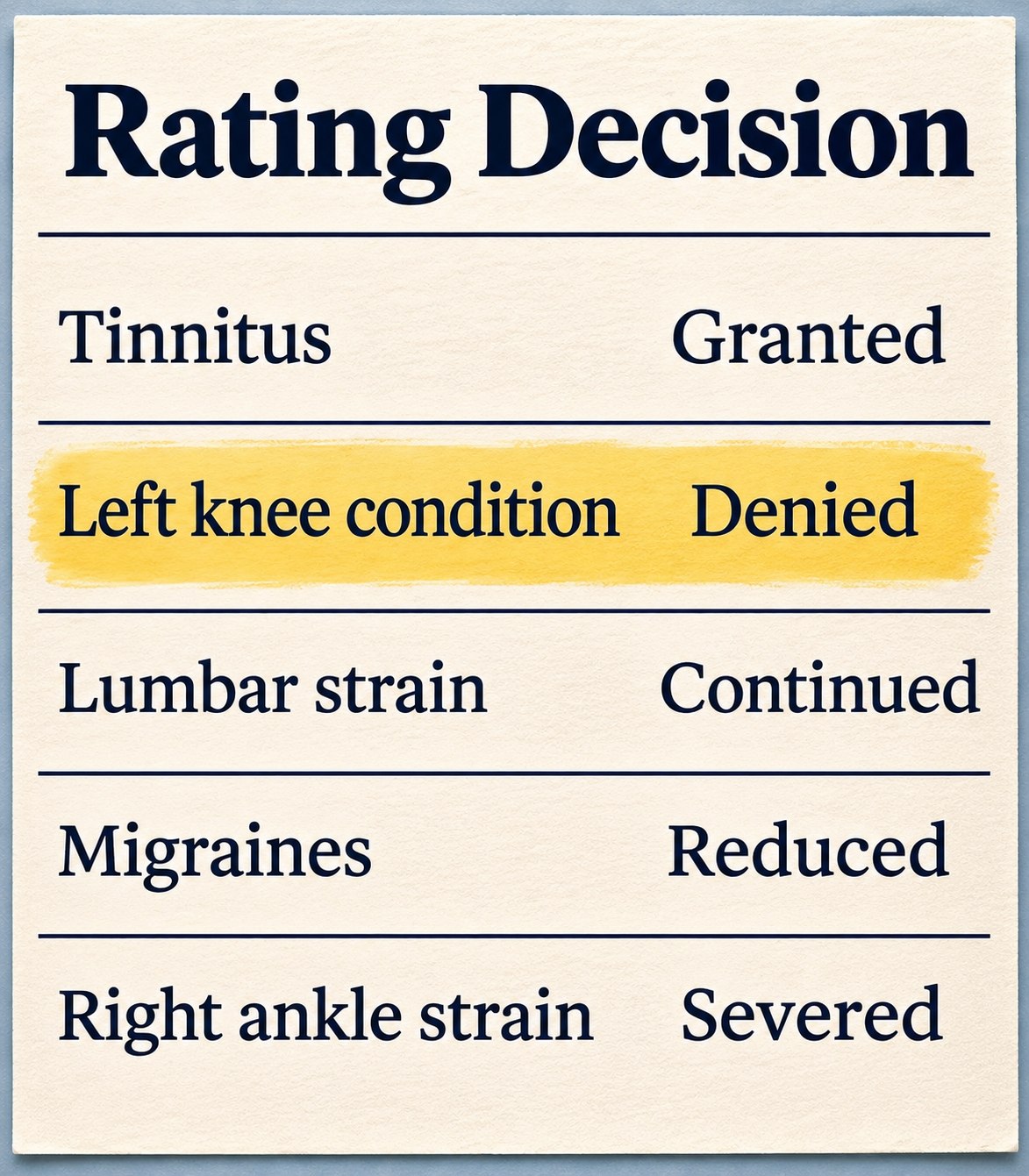
If an issue says “deferred,” VA is still working on it. Check the outcome for each issue separately.
If VA proposes a reduction or severance, check that notice for the deadlines to respond or request a hearing. The reduction and severance examples below show final decisions. Read the VA rules for proposed and final actions.
The decision notice
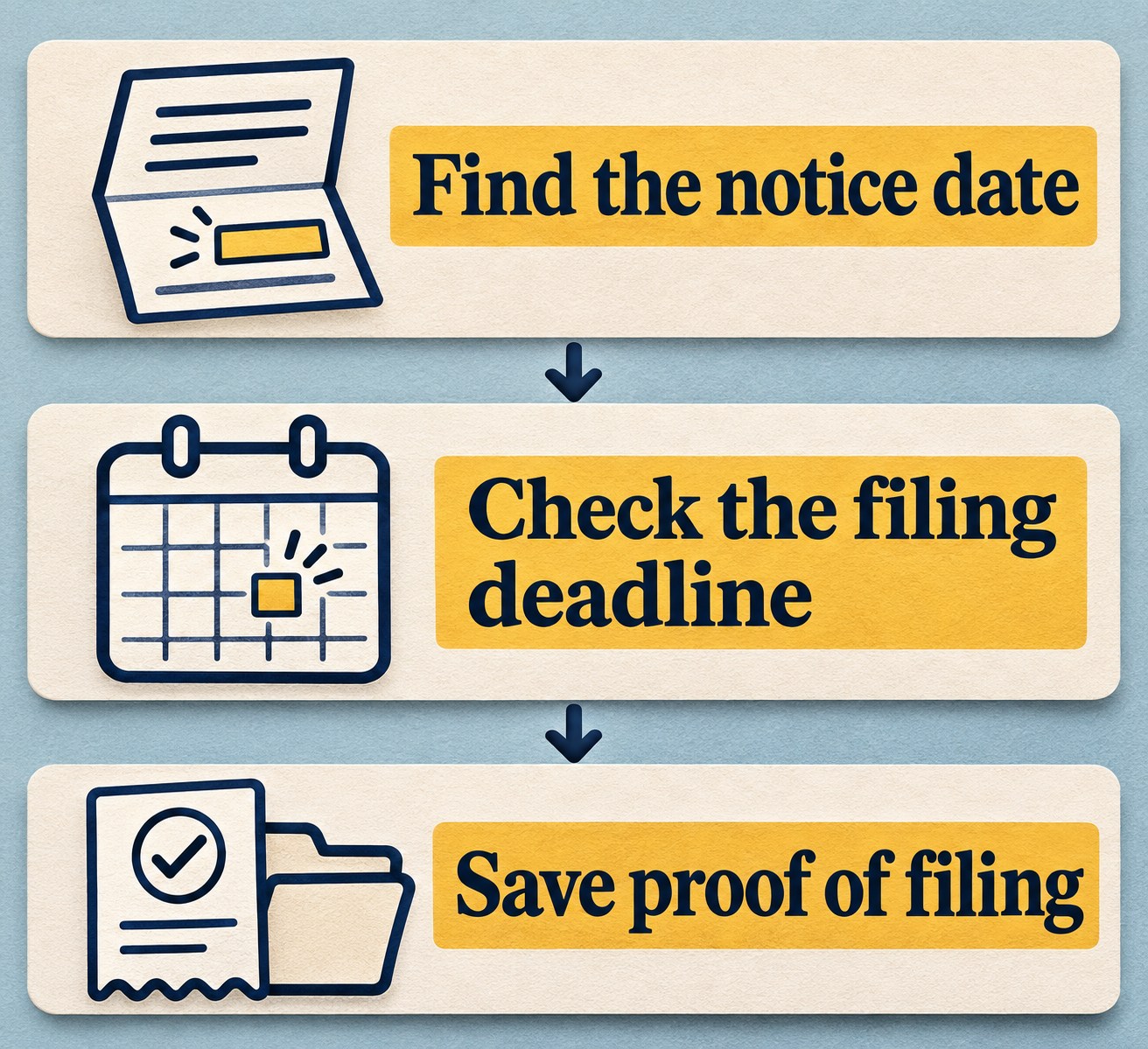
- Letter date. Write down the date printed on the notice and keep the full packet together. Use that date and the review instructions to check the deadline for the issue you want reviewed.
- What VA decided. Find the summary of what VA granted, denied, or changed. If you claimed several conditions, match each issue to the same issue in the decision narrative for the explanation.
- Award and payment information. If your benefits changed, look for the combined rating, monthly amount, and payment start date. If the notice has a payment table, read each row for changes over time. The payment start date can differ from the effective date assigned to a condition.
- Review rights. Look for the instructions on what to do if you disagree. The notice may include VA Form 20-0998, which explains your review rights. Check the notice for the options, filing instructions, and deadline for your issue.
- What VA asks you to do. Check the rest of the letter and its enclosures for any forms or information VA asks you to send. Note any separate deadline and keep a copy of your response.
The decision narrative
- Introduction. Identifies the claimant and summarizes the Veteran’s qualifying service. Check that the service dates are correct.
- Decision. Find your condition or issue and its outcome. A single packet can include a grant for one issue and a denial for another.
- Evidence. Review the list of records, exams, medical opinions, and statements VA says it considered. Compare document names and dates with your copies. Make a note of anything you expected to see on the list.
- Reasons for Decision. Find the explanation for your issue. This is where VA cites the specific laws and regulations it used, explains what it accepted, and shows how it applied those rules to the evidence.
- References. Provides standard references for VA benefits law, such as a general reference to Title 38 of the Code of Federal Regulations (38 C.F.R.).
Annotated sample decision
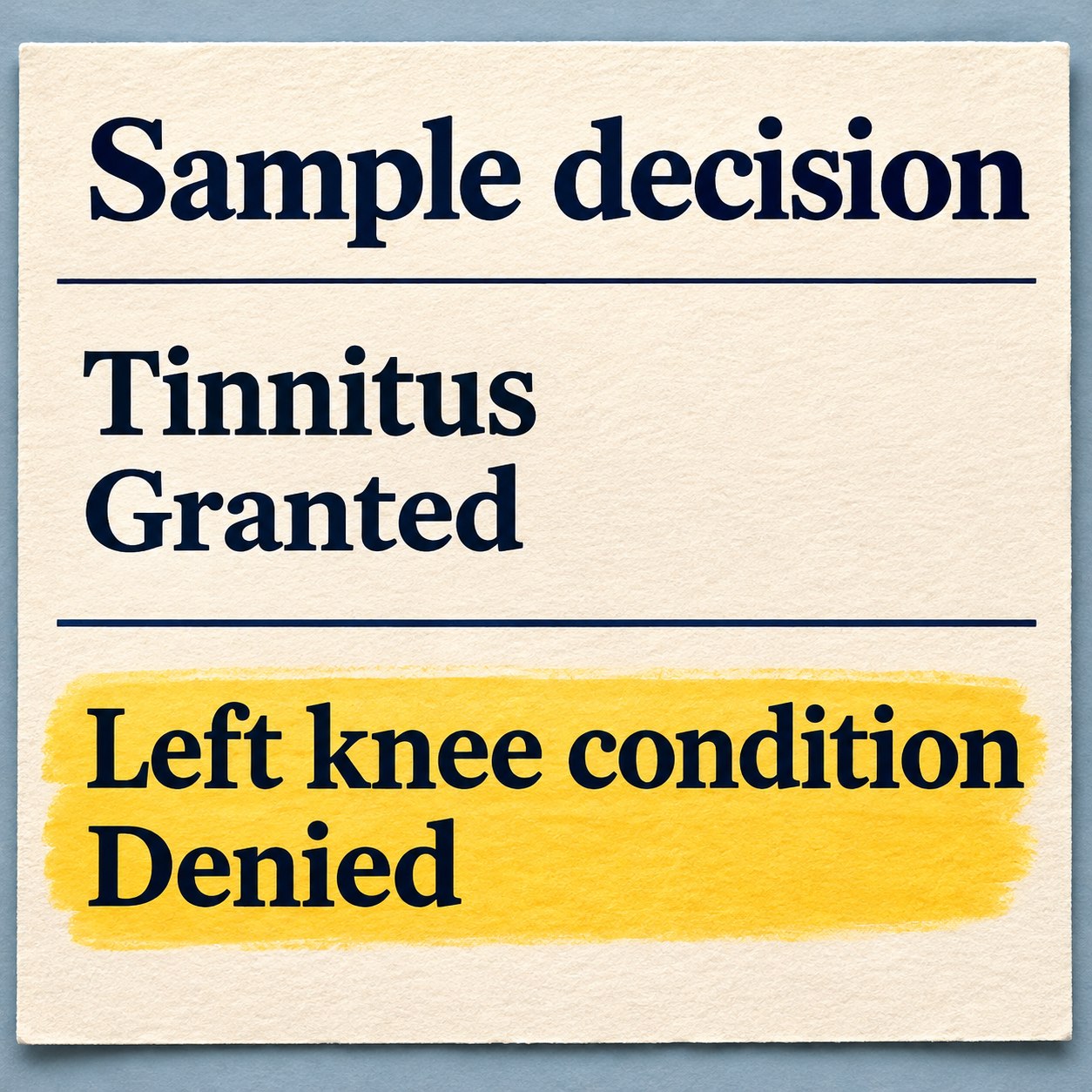
Fictional example of a VA decision packet for left knee strain.

- Notice date. September 18, 2026. Find this date at the top of the notice and use the review instructions to check your deadline.
- Decision. Service connection for left knee strain is denied. Match the condition and outcome to the issue you want to understand.
- Evidence. Service treatment record dated November 25, 2025, and VA knee exam and medical opinion dated May 28, 2026. Compare these document names and dates with your records.
- Reasons for Decision. VA accepted the current knee diagnosis and the treatment during service. The medical opinion did not link the current strain to that injury. This tells you which requirement VA found unmet.
Four examples from a rating decision
These fictional excerpts show what to look for. The wording and layout of your own decision may differ.
What a grant looks like
“Service connection for left knee strain is granted with a 10 percent evaluation effective June 3, 2026.”
- What VA granted. VA recognized the left knee condition as connected to military service.
- How VA rated it. The 10 percent applies to this condition. Check the reasons for that percentage and any explanation of what would support a higher rating. VA can also grant service connection at 0 percent.
- When the award takes effect. June 3 is the effective date in this example. Check the notice separately for any change to your monthly payment and when that payment rate starts.
What a denial looks like
“Service connection for left knee strain is denied.”
- What VA denied. VA declined to recognize this condition as service connected.
- Why VA denied it. In this example, VA found that the evidence did not establish a link between the current condition and service. In your own letter, write down the specific requirement VA says was unmet and the evidence it relied on.
- What VA accepted. In this example, the favorable findings acknowledge a current knee diagnosis and knee treatment during service.
What a rating reduction looks like
“The evaluation of left knee strain is reduced from 20 percent to 10 percent.”
- What VA changed. The knee remains service connected at a lower percentage.
- Why VA lowered the rating. Read the reasons VA gives and check which examinations or records it used. If VA says the condition improved, look for what it says changed since the previous rating.
- When it takes effect. Check the effective date of the reduction, then look at the notice for any change to the combined rating, monthly payment, or payment start date.
What removal of service connection looks like
“Service connection for left knee strain is severed.”
- What VA removed. Severance ends VA’s recognition of this condition as service connected.
- Why VA ended service connection. Read the reasons VA gives and the evidence it relies on. In many severance decisions, VA explains why it considers the earlier grant clearly and unmistakably erroneous.
- When it takes effect. Check the effective date of severance and any changes to the combined rating and monthly payment in the notice.
What “is continued” means
You may see this wording after a Supplemental Claim or a Higher-Level Review. Read what VA says it continued.
A prior denial stays in place
“The previous denial of service connection for left knee strain is confirmed and continued.”
The prior denial stays in effect. As with a first-time denial, look for the issue VA denied, the evidence it considered, why it denied the issue, and any favorable findings.
- After a Supplemental Claim. Check whether VA found the evidence new and relevant. If it did, read why the evidence still fell short of granting the benefit.
- After a Higher-Level Review. Read what the senior reviewer found in the evidence already in the record and why the prior outcome stayed in place.
An existing rating stays the same
“The 10 percent evaluation for left knee strain is continued.”
In this example, the knee remains service connected at 10 percent. If you asked for a higher rating, VA declined that increase. Look for the same details you would check in a grant. Confirm the condition, the percentage, the reasons for that percentage, and any effective date listed. Look for the criteria VA says would support a higher rating. If you need to confirm the effective date of the rating VA kept, check the prior decision that assigned it.
Use the date and review instructions on the new decision notice to check the next options for that issue.
Before comparing review options, write down the issue, VA’s outcome, the reason, and the notice date. For a grant, also note the rating and effective date. If you disagree, identify exactly what you want VA to change.
Compare the three review options
Ask two questions about the issue you disagree with. Do you need VA to consider new evidence? Who should review the decision?
Already had a review? See what you can do after a Supplemental Claim, Higher-Level Review, or Board decision.
Supplemental Claim
New evidence
Usually new and relevant evidence
Hearing or conference
You can request a hearing
Who reviews it
A VA claims reviewer
VA form
20-0995
New evidence is information VA did not previously have in the record for the decision. Relevant evidence helps prove or disprove something at issue.
For example, a new medical opinion may address a connection to service that VA found missing. You can submit evidence or identify records you want VA to help obtain. Some changes in law can also support this pathway.
Higher-Level Review
New evidence
VA uses the existing record
Hearing or conference
Optional informal conference
Who reviews it
A more senior VA reviewer
VA form
20-0996
The reviewer considers only the evidence in the record when VA issued the decision notice. You can include a written statement with your review request. Identify the issue you disagree with, explain why you think VA got it wrong, and point to evidence already in the record that supports your explanation.
For example, the reviewer can examine whether VA applied the wrong rating criteria to evidence it already had. In an informal conference, you can point out where you think VA made an error.
Board Appeal
New evidence
Allowed with Evidence Submission or Hearing
Hearing or conference
Available with the Hearing option
Who reviews it
A Veterans Law Judge
VA form
10182
Choose one of three Board options based on the evidence you want considered and whether you want a hearing.
- Direct Review. The judge reviews the existing record. No hearing or new evidence.
- Evidence Submission. Submit evidence with the appeal or within 90 days after VA receives it. No hearing.
- Hearing. You may submit evidence at the hearing or within 90 days afterward.
Writing a statement for your review? Read the statement-writing guide.
Check the deadline and what comes next
For most modernized disability compensation decisions, you have one year from the date of the decision notice to request Higher-Level Review or a Board Appeal. Some notices have shorter deadlines or different procedures. Start with the instructions on the letter, especially if it mentions a contested claim, a proposed reduction, or a legacy appeal.
Supplemental Claim. Filing within one year can help preserve a possible earlier effective date. A Supplemental Claim may still be available after one year. In that case, the effective date of any award is generally no earlier than the date VA receives the Supplemental Claim.
After you file, keep a copy of what you sent and a dated receipt or confirmation.
Protect a possible earlier effective date
Filing the appropriate review on time can preserve a possible earlier effective date. VA calls timely, successive reviews of the same issue continuous pursuit.
Use one review option at a time for the same issue.
If you disagree after a review
- After a Supplemental Claim. Consider Higher-Level Review, a Board Appeal, or another Supplemental Claim with new and relevant evidence.
- After Higher-Level Review. Consider a Board Appeal or a Supplemental Claim with new and relevant evidence.
- After a Board decision. For a final Board decision you disagree with, you generally have 120 days to appeal to the U.S. Court of Appeals for Veterans Claims. A Supplemental Claim with new and relevant evidence may also be available.
Get help with your next step
An accredited VSO representative, claims agent, or attorney can help you read the notice, identify the issue you want reviewed, and confirm your filing options. Bring the decision letter, the rating decision if it came separately, and a list of records you think matter.
The requirements for a VA decision notice are in 38 U.S.C. § 5104.